Table of Contents
- Why Hiring the Right Contractor Matters for Home Additions
- Home Addition Contractor Checklist: What to Verify Before You Hire
- Questions to Ask a General Contractor Before Signing
- How to Compare Contractor Quotes and Estimates
- Home Addition Project Timeline: What to Expect
- Common Contractor Mistakes and How to Avoid Them
- Design-Build vs. Hiring Separate Contractors
- Frequently Asked Questions
Last Updated: October 20, 2026
Why Hiring the Right Contractor Matters for Home Additions
Selecting the right contractor for a home addition can mean the difference between a project that transforms your home on time and within budget versus one that drains your savings for months.
A poorly chosen contractor can cut corners on structural integrity, miss permit deadlines, or abandon the project mid-way.
Homeowners who vet contractors upfront can save significant money and avoid costly delays by asking the right questions, understanding what a complete quote should include, and recognizing red flags before signing.
Home Addition Contractor Checklist: What to Verify Before You Hire
Before you hire any contractor for a home addition, verify three critical areas: licensing and insurance status, portfolio quality, and references from past clients.
Licensing, Insurance, and References
A licensed, insured contractor is your first line of protection.
Insurance is equally critical. Request proof of liability insurance and workers’ compensation coverage, which protects you if someone is injured on your property or neighboring structures are damaged.
References reveal how a contractor treats clients over time. Ask for at least three from projects completed in the past two years, ideally similar in scope.
Contact references directly by phone, not email. People are more candid in conversation, and you’ll pick up on hesitation or enthusiasm that written responses won’t show.
Portfolio and Past Projects
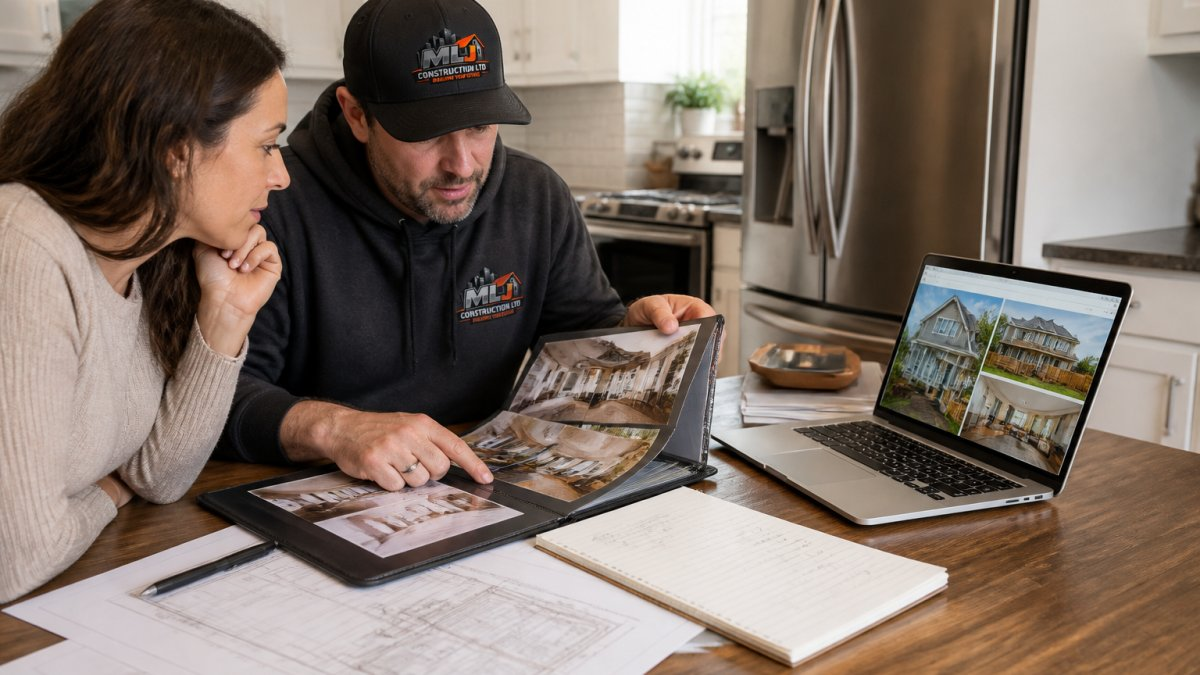
Review the contractor’s portfolio of completed home additions. Photos should show finished interiors and exteriors, not just work-in-progress shots.
Request to visit one or two completed projects in person. Walk through the space, open cabinets, check for gaps or uneven surfaces, and assess the craftsmanship. Tangible evidence beats promises.
Questions to Ask a General Contractor Before Signing
The questions you ask reveal whether a contractor has thought through your project or is just quoting a number.
Design, Permits, and Building Code
Ask: “Who handles permit applications and building inspections?” Some treat permits as an afterthought; others have established relationships with local inspectors.
Follow up with: “What building codes apply to this addition, and how will you ensure compliance?” The answer should reference specific codes relevant to your jurisdiction, structural, electrical, energy efficiency.
Ask about the design phase: “Will you work with an architect or designer, or build from my existing plans?” Understanding their process prevents misalignment later.
Payment Terms and Schedule
Never pay the full project cost upfront. Ask: “What’s your payment schedule?” A typical structure is 30% down upon signing, 40% at mid-project, and 30% upon completion.
Request a detailed timeline: “When will you start, and what’s the expected completion date?” A realistic contractor breaks this down by phase: design, permits, foundation, framing, mechanical systems, finishing.
Contractors who promise unrealistically fast timelines often cut corners or abandon the project for more profitable work. A home addition typically takes several months depending on scope; if someone promises an unrealistically short timeframe, they’re either inexperienced or planning to rush through critical steps.
How to Compare Contractor Quotes and Estimates
Comparing multiple quotes is essential, but not all quotes are equal. Most homeowners compare headline totals instead of scope, allowances, and exclusions line by line.
What a Complete Quote Should Include
Red flags appear when a quote is vague: “Labor: $X” without detail, or “Materials: $X” without listing what materials. Vague quotes make fair comparison impossible and often lead to surprise costs mid-project.
Ask whether the estimate accounts for permit costs, inspections, and required engineering or design work, often overlooked but able to add thousands to your total.
| Quote Component | What to Verify | Red Flag |
|---|---|---|
| Labor breakdown | Itemized by trade and phase | Lump sum with no detail |
| Materials list | Specific products and quantities | Generic “materials TBD” |
| Timeline | Start date, milestones, completion | No dates or vague timeline |
| Payment schedule | Percentage at each milestone | Demands 50%+ upfront |
| Exclusions | Clearly states what’s not included | Silent on what’s excluded |
| Warranty | Specifies coverage period | No warranty mentioned |
| Allowances | Dollar figure and what happens if exceeded | Open-ended “to be selected” |
| Contingency | Stated percentage and who controls it | No contingency line at all |
Realistic Cost Ranges and What Drives Them
Exact prices vary by region, design, and site conditions, so treat any single number with suspicion. Understand the cost drivers and ask each bidder to price them explicitly so bids become comparable.
- Size and complexity. A simple box addition costs less per square foot than an L-shaped addition with a bathroom, plumbing rough-in, or a vaulted ceiling. Ask each contractor for a cost-per-square-foot figure and the assumptions behind it.
- Foundation and site work. Sloped lots, poor soil, high water tables, and the need to tie into existing services can swing foundation costs substantially. Ask whether site work and excavation are included or treated as an allowance.
- Structural tie-in. Cutting into an existing wall, adding a beam, or upgrading the electrical panel are commonly under-scoped. Ask each bidder to confirm these are priced, not assumed.
- Finishes and fixtures. Kitchens and bathrooms are finish-heavy. Ask for a finishes allowance in dollars and what happens if selections exceed it.
- Permits, engineering, and inspections. These should appear as separate lines, not buried in a lump sum.
A practical method: build a one-page comparison sheet with the same rows for every bidder. Where a bidder leaves a row blank, write “not included” rather than assuming it is.
Ask every bidder to quote against the same written scope document and the same set of drawings. If one bidder is pricing a different scope, you are not comparing contractors, you are comparing two different projects.
Contingency and Change-Order Guidance
Even a well-scoped addition encounters surprises once walls are opened. Hold a contingency reserve of roughly 10 to 15 percent of construction cost for a straightforward addition, more for older homes or projects that alter structure or services. Ask each contractor how they handle change orders: who signs, how the price is set, and whether there’s a markup.
Red Flags in Bids and Estimates
A quote significantly lower than others should trigger investigation, not celebration. If three contractors quote $85,000, $92,000, and $65,000, the low bid likely cuts corners or misunderstood the scope.
Watch for quotes that change mid-conversation.
Avoid contractors who pressure you to decide quickly. “I can only hold this price for 24 hours” is a pressure tactic.
Home Addition Project Timeline: What to Expect
Understanding the typical timeline for a home addition helps you plan your life around the disruption and recognize when a contractor is falling behind.
Planning and Permitting Phase
Before construction starts, allow 4-8 weeks for design finalization and permit approval. If you’re working with an architect, they’ll create detailed plans; your contractor reviews them, identifies buildability issues, and coordinates with the municipality on permit applications.
Permit timelines vary by location. Some municipalities process permits in 2-3 weeks; others take 6-8 weeks or longer, especially with structural engineering review or a backlog.
Construction Duration and Disruption
The actual construction phase typically takes 12-20 weeks for a modest room addition, longer for complex projects like kitchen renovations or basement finishing.
Expect significant disruption: noise, dust, material deliveries blocking your driveway, workers arriving early. A professional contractor manages this with clear site rules, specific work hours, designated material storage areas, and daily cleanup protocols.
The total project duration, from initial consultation to final walkthrough, is typically 6-9 months. Planning your life around this timeline prevents frustration when construction extends into months you didn’t anticipate.
Common Contractor Mistakes and How to Avoid Them
Homeowners often make mistakes when hiring contractors for home additions that cost them time and money. The most expensive ones are rarely about picking the wrong tile, they’re about missing warning signs before money changes hands.
The Mistakes That Cost the Most
The first mistake is choosing based solely on price. The lowest bid often reflects inexperience, poor planning, or an intention to cut corners.
The second mistake is not getting everything in writing. Verbal agreements disappear when disputes arise.
The third mistake is failing to plan for permit delays.
The fourth mistake is not setting clear communication expectations.
Red Flags and Contractor Scams to Watch For
Most problems are visible before the contract is signed. Learn the patterns:
- Pressure to decide immediately. A legitimate contractor will still be there next week. Urgency is a sales tactic, not a scheduling reality.
- A bid far below the others with no explanation. Ask for the itemized scope. If the answer is vague, the bid is not real.
- Requests for large upfront payments. A deposit is normal; paying most of the project before work starts is not. Be especially wary of requests to pay in cash or to a personal account rather than a business account.
- No written contract, or a one-page contract with no scope. If the scope, payment schedule, and warranty are not written down, you have no protection.
- No verifiable business presence. Ask for the legal business name, a business address, and proof of insurance and workers’ compensation coverage. Cross-check the name against your province’s contractor licensing or registration records where such a registry exists.
- Reluctance to provide references or to let you visit a completed project. A contractor with a solid record will welcome the check.
- Door-to-door or unsolicited offers after a storm or a nearby renovation. Unsolicited work is a common entry point for fly-by-night operators.
- Requests to pull the permit in your name to avoid scrutiny. Permits and inspections protect you; be cautious when a contractor wants to route around them.
If a contractor asks you to sign a “design agreement” or “estimate” that contains binding terms, read it as a contract. Some agreements include cancellation fees or authorize work before you have compared bids.
A Simple Vetting Routine
Before signing, do four things in this order: confirm licensing and insurance in writing, call at least three recent references, visit one completed project, and read the contract line by line against the scope. If any step feels rushed or resisted, treat that as information. The right contractor will make the process easy because they have nothing to hide.
Design-Build vs. Hiring Separate Contractors
Two approaches exist: hire a general contractor to build from plans you provide, or work with a design-build firm that manages design and construction as one integrated service.
Design-build simplifies decision-making because one entity is responsible for both design and construction quality.
MLJ Construction Ltd. offers design-build services that integrate planning, permitting, and construction management.
Hiring contractors for home additions is one of the most important decisions you’ll make as a homeowner.
The right contractor brings expertise, reliability, and clear communication. They manage permits, coordinate trades, and deliver quality workmanship that lasts.
Frequently Asked Questions
What should I look for when hiring contractors for home additions?
Verify licensing, insurance, and references first. Review their portfolio of completed additions to confirm experience with your project type. Ask for a detailed written estimate that breaks down materials, labor, and timelines. Check customer reviews and ask for contact details of past clients. A reputable contractor will provide clear answers to all your questions and explain their process for managing permits, building codes, and project coordination.
How long does a typical home addition project timeline take?
Most residential additions take several months from start to finish, though this varies by project scope and complexity. Planning and permitting typically requires a number of weeks. Construction itself usually spans several months depending on size and structural requirements. Weather, permit delays, and unforeseen issues can extend timelines. Your contractor should provide a detailed schedule upfront and communicate any changes promptly.
How do I compare quotes from different home addition contractors?
Request detailed written estimates from at least three contractors that break down labor, materials, permits, and contingencies. Ensure all quotes are based on the same design plans and specifications. Compare not just price but what’s included: do they handle permits, inspections, and code compliance? Watch for suspiciously low bids, vague line items, or missing components. The cheapest option often means corners cut on quality or hidden costs later.
What questions should I ask a general contractor before hiring?
Ask about their experience with additions similar to yours, their process for obtaining permits and ensuring code compliance, payment schedule and terms, how they handle changes or delays, and who manages the project daily. Inquire about their relationship with architects and engineers, their approach to quality control and workmanship, and their post-construction follow-up. Request references and ask previous clients specifically about budget adherence and timeline accuracy.