Table of Contents
- Why Choosing the Right General Contractor Matters
- Start With Referrals and Online Reputation Checks
- Verify Licensing, Insurance and WSIB Coverage
- Questions to Ask a General Contractor Before Hiring
- How to Compare Contractor Quotes Side by Side
- General Contractor Checklist for Vetting Candidates
- What to Include in a Construction Contract and Red Flags to Avoid
- Booking Your Consultation to Start Your Project
- Frequently Asked Questions
Why Choosing the Right General Contractor Matters
Last Updated: November 5, 2026
Hiring the wrong general contractor is one of the most expensive mistakes a homeowner or business owner can make. Delays, cost overruns, and poor workmanship often trace back to the initial selection, not to the build itself.
A general contractor coordinates the entire build. That includes scheduling trades, ordering materials, managing inspections, and answering to you when something goes wrong. Because one firm controls so many moving parts, its competence shapes almost every outcome. A good contractor keeps the project on schedule and within budget.
The stakes are highest on larger jobs. Whole-home renovations, residential additions, and commercial fit-outs involve permits, structural changes, and tight coordination with architects and engineers. Errors made early, such as an unrealistic quote or a vague scope, tend to multiply later as change orders.
This guide walks through a practical process: finding candidates, verifying credentials, comparing quotes, asking the right questions, and reviewing the contract before signing. Each step is designed to reduce risk.
Start With Referrals and Online Reputation Checks
Start with people who have already hired a contractor and lived with the result. Past clients, neighbours, architects, and building suppliers can point you toward firms that finish projects well. Ask specific questions: Did the contractor stick to the schedule? How were change orders handled?
Then check the online record. Review platforms, Google reviews, and local business listings show patterns over time. To judge workmanship quality beyond what online reviews show, see how to verify contractor workmanship quality.
Ask for a portfolio of completed work, and ideally visit a finished project. Photos are useful, but seeing workmanship in person tells you more about finish quality, cleanliness, and attention to detail. Some contractors will also put you in touch with recent clients for a direct conversation.
Keep a short shortlist of three to five firms at this stage. For guidance on finding reliable local construction companies, see how to find reliable Windsor construction companies. A longer list is hard to evaluate properly, and a shorter one may leave you without enough competitive quotes later.
Verify Licensing, Insurance and WSIB Coverage
Before you compare prices, confirm that the contractor is legitimately operating. In Ontario, verify that the business is properly registered and that its workers are covered by the Workplace Safety and Insurance Board (WSIB) (Coverage Status). Ask for a current WSIB clearance certificate and check its date.
Ask for proof of liability insurance as well. A certificate of insurance should name your property or project and show coverage limits that suit the scale of the job.
Also ask which trades the contractor employs directly and which they subcontract. Confirm that subcontractors carry their own WSIB coverage and insurance. Gaps in coverage at the subcontractor level are a common source of disputes after an accident.
Verify any licences the work requires, such as electrical or plumbing permits pulled through the municipality. Your local building department can confirm permit requirements and whether a contractor has a record of compliant work.
Questions to Ask a General Contractor Before Hiring
Structured questions reveal how a contractor actually works. The same questions about experience, on-site responsibility, and communication are useful when choosing a reputable contractor for roofing work.
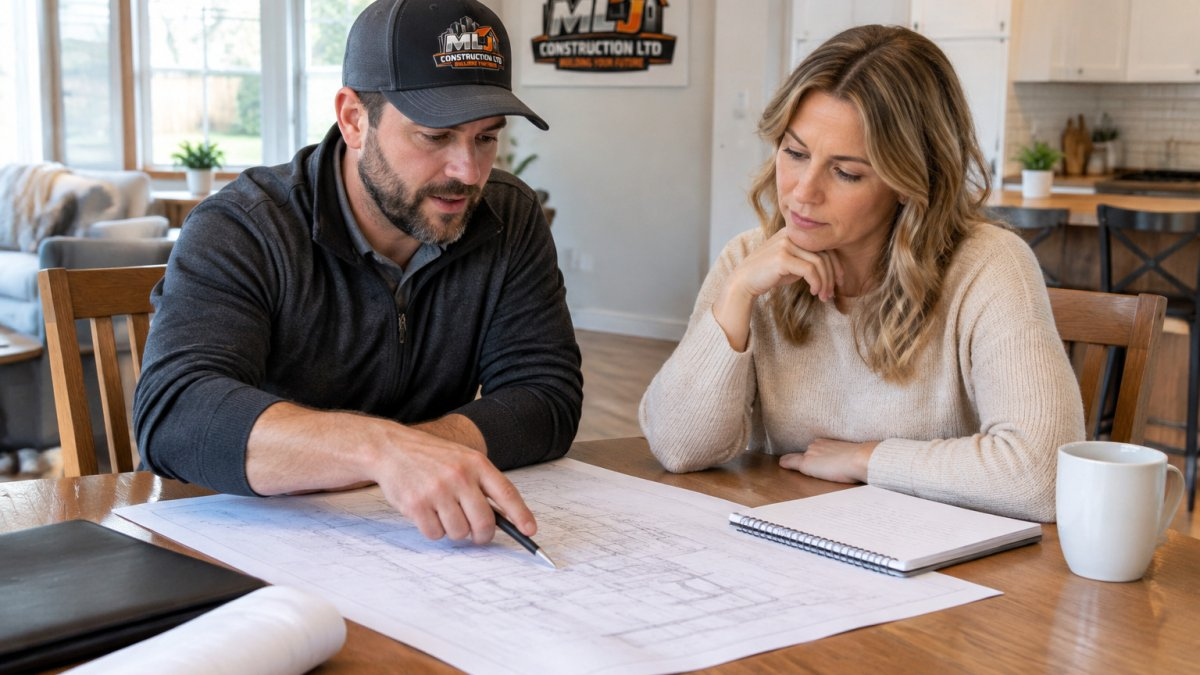
Next, ask about process. How do you prepare a project schedule, and how often will you update it? Who handles permits and inspections? How do you communicate progress, through weekly meetings, email, or a project portal? Clear answers here predict how smoothly the build will run.
Ask about money directly. How do you price projects, and what is included in your fee? How are change orders priced and approved? What payment schedule do you require, and is it tied to completed milestones rather than dates?
Finally, ask how the firm handles problems. What is your warranty, and what happens after completion? How do you handle disputes with subcontractors or with clients?
Structured questions reveal how a contractor actually works, covering experience, process, money and problem handling.
| Question area | What to ask | What a clear answer shows |
|---|---|---|
| Experience | How many similar projects in the last few years? | Relevant track record |
| Process | How often is the schedule updated? | Predictable communication |
| Permits | Who handles permits and inspections? | Clear responsibility |
| Money | How are change orders priced and approved? | Controlled costs |
| Payments | Are payments tied to completed milestones? | Lower financial risk |
| Problems | What is the warranty and post-completion follow-up? | Accountability after handover |
How to Compare Contractor Quotes Side by Side
Quotes are only comparable when they describe the same work. Before you look at totals, confirm every bidder received the same drawings, specifications, and scope of work. If one contractor priced from a sketch and another from a full drawing set, the numbers tell you nothing. Send the same package to every bidder and ask each to confirm in writing what they received.
Then normalize the bids before you compare them. A practical framework is to rebuild each quote into the same six categories, using the contractor’s own line items:
- Scope and quantities: What is being built, and in what quantity? Look for square footage, linear feet, and unit counts. A quote that says “renovate kitchen” without quantities cannot be compared to one that lists cabinet runs, tile area, and fixture counts.
- Allowances: An allowance is a placeholder dollar figure for an item not yet selected, such as tile, lighting, or cabinetry. A $2,000 tile allowance and a $6,000 tile allowance are not the same bid. Ask what happens when the selection exceeds the allowance, and who pays the difference.
- Exclusions: What is explicitly not included? Demolition, disposal, engineering, permits, temporary power, protection of finishes, and final cleaning are common omissions. List every exclusion across all bids and price the gaps yourself, or ask each contractor to add them.
- Labour versus materials: Separate the two where the quote allows. Labour-heavy quotes and material-heavy quotes behave differently when scope changes, and a low material line often signals a lower grade of product.
- Contingency: A reasonable contingency on older buildings protects both sides. An unusually low contingency, or none at all, usually means the contractor expects to recover the difference through change orders.
- Schedule and long-lead items: Compare start and completion dates, and check whether delivery of long-lead materials such as windows, cabinetry, or specialty fixtures is built into the timeline. A cheap bid that cannot start for four months is not the same product.
Build a simple comparison table with those six rows and one column per bidder. Once a price is agreed, how to avoid construction budget overruns explains how to keep costs from climbing. Then ask each contractor to explain any gap of more than about ten percent between their bid and the median. The explanation often tells you more than the price. A contractor who can walk you through the difference line by line is demonstrating exactly the cost control you are hiring.
Watch out: a quote far below the others usually means something has been left out, and the omission tends to reappear later as a change order at a less convenient moment.
Finally, confirm what the price actually buys. To see how contractors charge fixed versus percentage project management fees, read how to evaluate a general contractor’s project fee. Ask whether the quote is fixed-price or cost-plus, whether the contractor’s fee is a flat amount or a percentage of project cost, and whether the fee changes if the scope grows.
General Contractor Checklist for Vetting Candidates
Use this checklist to evaluate each finalist consistently:
- Operates as a registered business with a verifiable address and phone number
- Holds a current WSIB clearance certificate
- Provides a certificate of liability insurance for the project
- Has completed projects similar in scale and type to yours
- Provides at least three recent client references you can contact
- Reviewed in multiple independent sources with responses to complaints
- Submits a written, itemized quote with explicit exclusions
- Explains the fee structure in plain terms
- Names the project manager and site supervisor
- Describes the permit and inspection process
- Offers a written warranty and explains post-construction follow-up
A contractor who fails more than two or three items should move down your list, regardless of price.
What to Include in a Construction Contract and Red Flags to Avoid
A written contract protects you more than any verbal assurance. At minimum, it should include the full scope of work, specifications for materials, the start and completion dates, the payment schedule, and the process for approving change orders.
Payment structure deserves more attention than it usually gets.
Change orders are where budgets quietly fail. The contract should state, in plain terms, how a scope change is priced, who approves it, and how it is documented before the work proceeds.
Lien exposure is the risk most homeowners underestimate. Subcontractors and suppliers who are not paid may have claims against the property, even if you have already paid the general contractor.
Be cautious of these red flags:
- Requests for a large cash deposit before any work begins
- Payment demanded in full before milestones are completed
- Verbal promises that do not appear in the written contract
- Pressure to sign quickly, or a quote that expires within days
- Refusal to provide references, insurance certificates, or a WSIB clearance
- Vague language such as “all necessary work” without defined scope
- No written procedure for change orders
- A contract that names a different entity than the one you vetted
Keep records of all approvals, change orders, inspection results, and payment receipts. When a dispute arises, a clear paper trail makes resolution far faster, and it is the difference between a conversation and a claim.
Booking Your Consultation to Start Your Project
Choosing a general contractor is a decision you can make with confidence when you apply the steps above. Verify credentials first, compare quotes on equal scope, ask structured questions, and insist on a clear contract before any money changes hands. MLJ Construction Ltd. offers a single point of contact for design-build and general contracting projects across residential, commercial, and industrial work. To discuss your project and receive a detailed quote, book your consultation.
Frequently Asked Questions
How do I find a reliable general contractor?
Start with referrals from neighbours, friends, architects and engineers you trust, then check each candidate’s reputation through online reviews and past clients. Ask to see completed projects similar to yours, and confirm the contractor is licensed or registered where required in Ontario. A reliable contractor will readily provide references you can call and will explain their process in writing before you sign anything.
What should I look for when choosing a general contractor?
Look for relevant experience with your project type, valid insurance including liability coverage, WSIB coverage for workers, and a clear communication process. Confirm they will pull the required building permits and manage subcontractors. Strong candidates provide detailed written estimates, a realistic schedule and a named project lead you can contact directly during construction.
How many contractor quotes should I get?
Most homeowners should collect at least three written quotes for a project of meaningful size. Quotes are only comparable when each contractor priced the same scope, materials and finishes. Pricing depends on quantity, dates and delivery, so ask each contractor for a current quote rather than relying on estimates from another project. Request a quote from MLJ Construction Ltd. through our website to compare directly.
What are red flags when hiring a general contractor?
Watch for requests for a large cash deposit before work starts, unwillingness to provide proof of insurance or WSIB coverage, and estimates that are far below the others without explanation. Be cautious of contractors who avoid written contracts, pressure you to sign quickly, or cannot name recent clients. Any reluctance to put scope, payment schedule and change order terms in writing is a warning sign.
What should a general contractor’s contract include?
A solid construction contract includes the full project scope, material and product specifications, a payment schedule tied to completed milestones, the start and completion dates, and a process for change orders and delays. It should name the responsibilities of each party, the warranty period and how disputes will be resolved. Review the document with a lawyer before signing if the project is large.
How can I check a contractor’s references and past work?
Ask for at least three references from recent projects of similar size and type, then call them and ask about budget control, schedule performance and how problems were handled. Visit a completed job if possible and look at workmanship, cleanliness and finish quality. Reputable contractors will welcome these checks and often share portfolios that show before and after results.
